One of the cool things about being an editor is being able to see an author's thought process. Working with custom textbooks, I'm privy to the backroom deliberations of all sorts of professors, from those who want to whip up a few extra worksheets to those who want their books to be short, simple, to the point, and best of all inexpensive.
Today, though, I found myself working on a book which began with your basic Welcome-To-College freshman orientation-type book, the kind that teaches you how to take notes, how to study, how to stay awake in class.
They wanted this combined with a technical manual of the United States healthcare system.
Now, I have to ask myself: does that mean that there are healthcare professionals out there who don't know how to memorize? Is there an underlying problem with multi-tasking in the medical community?
I didn't want to ask. I guess there really is a market for everything.
Monday, June 14, 2010


Sunday, June 13, 2010
You Must Do the Thing You Think You Cannot Do
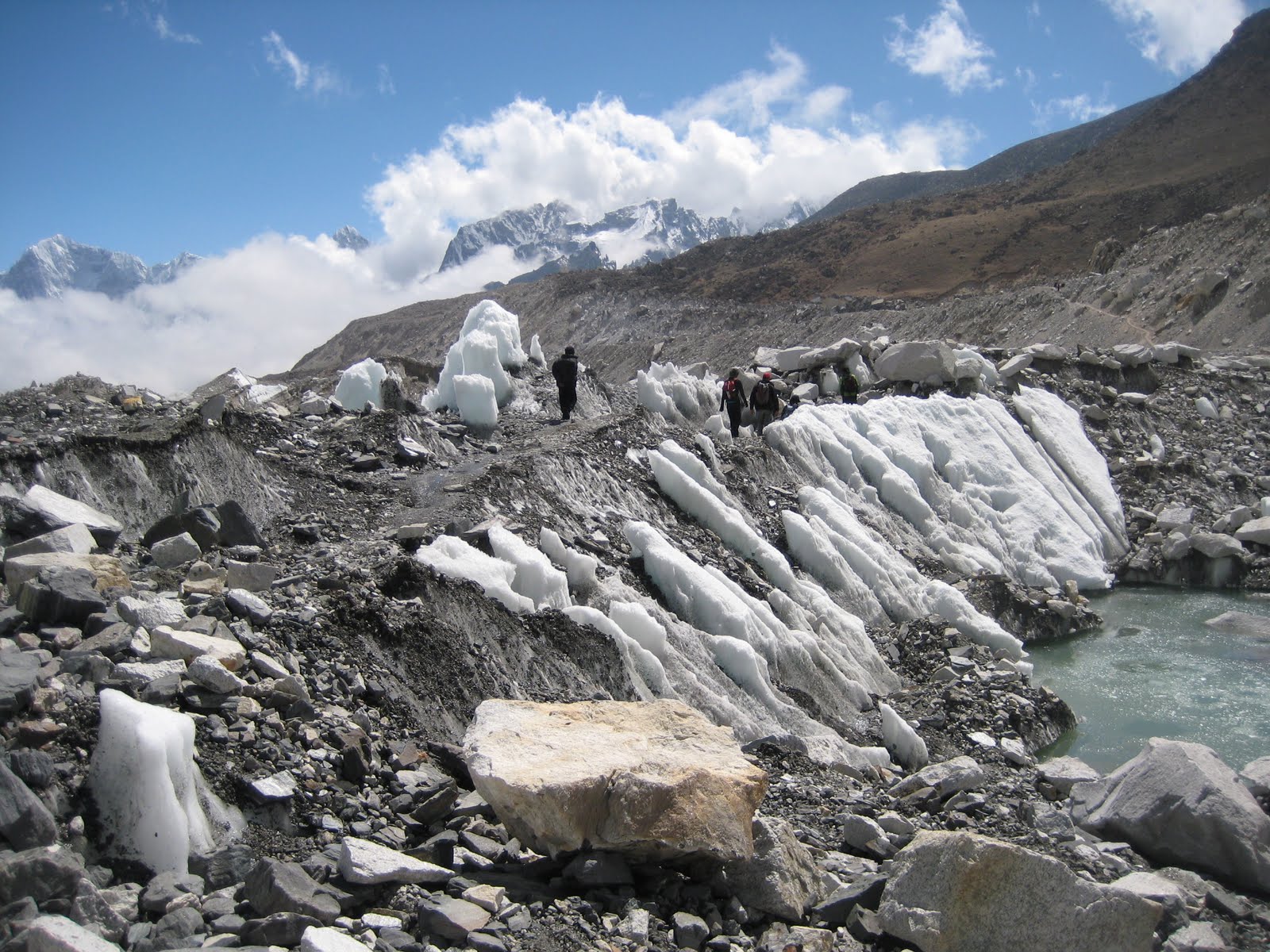
We were standing halfway up a treeless, rocky hill, something like 5,300 meters above sea level, the day after walking all the way to this:

Around Everest Base Camp, you're well above the tree line, and while in May you won't see much snow during the day, around you magnificent glaciers tower in all directions, punctuated by the occasionally rocky cliff. Every so often, you're able to see the tip of Everest itself poking shyly out from behind Nuptse, the 7,821 m "small" mountain positioned directly in front. To get the best look at the top of the world, one usually had to climb Kala Pattar, which we were standing beneath--"only" 5,545 meters, or 18,200 feet. Thousands of feet higher than the tallest mountain in North America.


We were debating: up or down.
Flash back to me the night before, at 5,200 meters, at the teahouse on our return from Everest Base Camp. The entire trip, I amongst our team had suffered the least from altitude sickness, which can cause nausea, headaches, loss of appetite, and in its more serious, dangerous stages, vomiting, disorientation, and death. I'd walked to EBC in high spirits, sat and had a lunch of Tibetan bread with my team to celebrate getting all twelve members to our goal, and then merrily trotted back down the hill to bed.
Except that, as soon as I'd unrolled my sleeping bag, I became terribly unwell. I found myself inexplicably sitting with my head on my knees, dead asleep in the middle of the dining room, only waking long enough to wanly place a halfhearted dinner order.
It took five minutes of staring at my noodle soup before I could get any down, and then I almost gave up on my omelette. The worst thing you can do at elevation, though, is take in too few calories. Another twenty minutes later, I persevered through the last bit of egg and pushed my plate away.
A fellow trekker, trying to console me, offered a bite of Cadbury. "If I feel like this tomorrow," I said limply, "I'm not going to Kala Pattar."
We were all feeling a little run-down, to be honest. We were on our eighth day of trekking at extreme altitude, and we had all developed Khumbu cough--a wet, persistent cough common above a certain elevation--and the air was so thin even walking took immense effort. Let alone walking uphill. Let alone walking to the top of a mini-mountain before sunrise to get a view of Everest. Rumor had it that you could see just as much from halfway up Kalla Pattar.


Halfway up was where my group now was, debating whether to call it a day and descend to our next camp, or whether anybody would actually try for the top.
I climbed a few feet above the group to have a moment with the view, still strugging for breath. Just about everyone wanted to descend. I was feeling better, but after struggling so badly I was nervous about going any further. Most of my compatriots agreed, and after snapping a few photos trudged back down with our guides.
But one Brit still wanted to go up. "Come on," he said. "It's only a piddly little hill." He and a guide gave us a wave and started walking.
I swore to myself and shook my head. I pointed at him with my walking stick. "We're going to walk slowly, OK?"
"Pardon?"
"We're walking slowly." Then I got into line behind him.
"Bugger," said another Brit, And then there were three. We trudged upwards.
It wasn't the steepest climb of my life, and I wasn't exactly speeding along, but that next half-hour was pure respiratory hell. Cough, wheeze, cough, wheeze, and all the while my legs and lungs burned with the exertion. Even our Sherpa guide just sort of trudged along, setting a snail's pace and looking spent.
It didn't matter. Even after being sure I wouldn't make it, even after questioning if I'd get out of bed, I found myself at the top of Kala Pattar with Everest, the South Col, Nuptse, Ama Dablam, and the whole Himalayan panorama surrounding me.
What's funny is, I had never seen a mountain until I was eighteen years old. I went to Vancouver for Spring Break my freshman year of college and my friends still laugh about how I hadn't known mountains came in ranges. Eight years later, I was on top of a Himalaya. A piddly little Himalaya, maybe, but on the horizon was the tallest mountain the world. I felt like hell, but it was worth every step.
The sun had already risen over Everest and the wind picked up, sending the prayer flags fluttering. "OK," I said, finally looking downhill. "Let's go home."


Around Everest Base Camp, you're well above the tree line, and while in May you won't see much snow during the day, around you magnificent glaciers tower in all directions, punctuated by the occasionally rocky cliff. Every so often, you're able to see the tip of Everest itself poking shyly out from behind Nuptse, the 7,821 m "small" mountain positioned directly in front. To get the best look at the top of the world, one usually had to climb Kala Pattar, which we were standing beneath--"only" 5,545 meters, or 18,200 feet. Thousands of feet higher than the tallest mountain in North America.

We were debating: up or down.
Flash back to me the night before, at 5,200 meters, at the teahouse on our return from Everest Base Camp. The entire trip, I amongst our team had suffered the least from altitude sickness, which can cause nausea, headaches, loss of appetite, and in its more serious, dangerous stages, vomiting, disorientation, and death. I'd walked to EBC in high spirits, sat and had a lunch of Tibetan bread with my team to celebrate getting all twelve members to our goal, and then merrily trotted back down the hill to bed.
Except that, as soon as I'd unrolled my sleeping bag, I became terribly unwell. I found myself inexplicably sitting with my head on my knees, dead asleep in the middle of the dining room, only waking long enough to wanly place a halfhearted dinner order.
It took five minutes of staring at my noodle soup before I could get any down, and then I almost gave up on my omelette. The worst thing you can do at elevation, though, is take in too few calories. Another twenty minutes later, I persevered through the last bit of egg and pushed my plate away.
A fellow trekker, trying to console me, offered a bite of Cadbury. "If I feel like this tomorrow," I said limply, "I'm not going to Kala Pattar."
We were all feeling a little run-down, to be honest. We were on our eighth day of trekking at extreme altitude, and we had all developed Khumbu cough--a wet, persistent cough common above a certain elevation--and the air was so thin even walking took immense effort. Let alone walking uphill. Let alone walking to the top of a mini-mountain before sunrise to get a view of Everest. Rumor had it that you could see just as much from halfway up Kalla Pattar.


Halfway up was where my group now was, debating whether to call it a day and descend to our next camp, or whether anybody would actually try for the top.
I climbed a few feet above the group to have a moment with the view, still strugging for breath. Just about everyone wanted to descend. I was feeling better, but after struggling so badly I was nervous about going any further. Most of my compatriots agreed, and after snapping a few photos trudged back down with our guides.
But one Brit still wanted to go up. "Come on," he said. "It's only a piddly little hill." He and a guide gave us a wave and started walking.
I swore to myself and shook my head. I pointed at him with my walking stick. "We're going to walk slowly, OK?"
"Pardon?"
"We're walking slowly." Then I got into line behind him.
"Bugger," said another Brit, And then there were three. We trudged upwards.
It wasn't the steepest climb of my life, and I wasn't exactly speeding along, but that next half-hour was pure respiratory hell. Cough, wheeze, cough, wheeze, and all the while my legs and lungs burned with the exertion. Even our Sherpa guide just sort of trudged along, setting a snail's pace and looking spent.
It didn't matter. Even after being sure I wouldn't make it, even after questioning if I'd get out of bed, I found myself at the top of Kala Pattar with Everest, the South Col, Nuptse, Ama Dablam, and the whole Himalayan panorama surrounding me.
What's funny is, I had never seen a mountain until I was eighteen years old. I went to Vancouver for Spring Break my freshman year of college and my friends still laugh about how I hadn't known mountains came in ranges. Eight years later, I was on top of a Himalaya. A piddly little Himalaya, maybe, but on the horizon was the tallest mountain the world. I felt like hell, but it was worth every step.
The sun had already risen over Everest and the wind picked up, sending the prayer flags fluttering. "OK," I said, finally looking downhill. "Let's go home."


Saturday, June 12, 2010
No Matter How Far You Go . . .
I define home as: the place you root for in the World Cup.

Don't tread on me . . . Go USA!

Don't tread on me . . . Go USA!
Wednesday, June 9, 2010
How to Entertain an Editor
With two months to go before the start of classes and literally hundreds of projects per editor to publish, my company is at fever pitch. In the height of the season, when we're chained to our desks, we've needed some creative ways to relieve stress.
One of the development editors put this sign up last year, a message borrowed from Her Majesty the Queen of England:

When I got back from India to start our busy season, I noticed our production editors had gotten a little wacky.


Eventually, a proofreader took it to its logical conclusion.

I guess this is what happens when you log too many hours looking for stray commas.
One of the development editors put this sign up last year, a message borrowed from Her Majesty the Queen of England:

When I got back from India to start our busy season, I noticed our production editors had gotten a little wacky.


Eventually, a proofreader took it to its logical conclusion.

I guess this is what happens when you log too many hours looking for stray commas.
Sunday, June 6, 2010
Paper Heart
Poverty is poverty, and coming back to America doesn't mean I see any less of it. In fact, one of the best things about being back is resuming my biweekly volunteer sessions at a wonderful organization: Boston Health Care for the Homeless Program. Every other week, I spend a Sunday afternoon at the respite center stringing beads or making tie-die with homeless patients sick enough to need medical care but not sick enough to be in the hospital.
It's always bittersweet walking through the door, because while it's nice to get to know the patients, you're always a little sad to see folks still there week after week. You hope they get their own homes, or their wounds heal, or their circumstances improve enough for them to move on. Whenever a patient tells me, "I won't see you again! I'm getting out next week!", my unequivocal reaction is, "Good!"
Today I made necklaces with a patient who had definitely been with the program a while, but who I mostly remembered as a guy liking to hoard craft supplies. Patients don't always remember me, but this guy did. "Where have you been?" he asked.
"I was abroad," I said. "India."
His face lit up. "I am half Indian!" he said. "And half Pakistani! And I've been all over." He then listed thirty or forty countries around the globe which he'd seen. He honestly listed more countries than I think I could even name off the top of my head. Turns out, he'd been in the Marines, and he'd gone on a few tours to far-off places. He spent the rest of the afternoon asking me laundry lists of questions. "Do you speak Hindi? Do you watch Bollywood? Did you go shopping? Did you see the Taj?"
Before I left, he made me get out the construction paper so he could make me something special. Just from memory, he started folding up an origami heart. Then, he handed it to me: a present. He told me that, if he had glue, he would have stuck sequins and stickers and fancy designs all over it. I said, "Well, why not keep working on it and give it to me when I come back?"
He said, no. He hopes he will not be at the center two weeks from now.
I hope not, too. May we not meet again, sir.

It's always bittersweet walking through the door, because while it's nice to get to know the patients, you're always a little sad to see folks still there week after week. You hope they get their own homes, or their wounds heal, or their circumstances improve enough for them to move on. Whenever a patient tells me, "I won't see you again! I'm getting out next week!", my unequivocal reaction is, "Good!"
Today I made necklaces with a patient who had definitely been with the program a while, but who I mostly remembered as a guy liking to hoard craft supplies. Patients don't always remember me, but this guy did. "Where have you been?" he asked.
"I was abroad," I said. "India."
His face lit up. "I am half Indian!" he said. "And half Pakistani! And I've been all over." He then listed thirty or forty countries around the globe which he'd seen. He honestly listed more countries than I think I could even name off the top of my head. Turns out, he'd been in the Marines, and he'd gone on a few tours to far-off places. He spent the rest of the afternoon asking me laundry lists of questions. "Do you speak Hindi? Do you watch Bollywood? Did you go shopping? Did you see the Taj?"
Before I left, he made me get out the construction paper so he could make me something special. Just from memory, he started folding up an origami heart. Then, he handed it to me: a present. He told me that, if he had glue, he would have stuck sequins and stickers and fancy designs all over it. I said, "Well, why not keep working on it and give it to me when I come back?"
He said, no. He hopes he will not be at the center two weeks from now.
I hope not, too. May we not meet again, sir.

Saturday, June 5, 2010
Ohhhhhm?
I went back to yoga class for the first time yesterday. Ironically, I didn't do a lick of yoga the entire time I was in India. I once tried, when I was in Rishikesh: the "birthplace" of yoga. My hotel offered free yoga lessons in the morning, every morning except for the one I inquired. After that, I didn't have the heart to seek out a class.
I kind of had to giggle when I went back to my gym, though. There is always the Yoga Guy who Takes Yoga Very Seriously and whose Down Dogs are always somehow the most stationary and yet the most distracting poses in the room. Then, at the end of class as we wake up from Corpse Pose, we murmur "Namaste" very soberly, very somberly. I think some of my classmates think "Namaste" means a lot more than "G'bye!"*
Meanwhile, I think back to the mornings I would jog in the park alongside my guesthouse. I would see classes going on in the open air day in, day out. The yoga practicers were all ages, all shapes, all levels of flexibility. Sometimes, men in kurtas and ladies in salwaar kameez would just do yoga outside, by themselves. And then, every so often, I would run into a group practice of my favorite yoga style ever: Laughing Yoga.

Laughing Yoga is exactly what it sounds like. You take a deep breath in, then let it out with a big "HAHAHAHAHA!" That's your warmup. Then there are a whole bunch of different laughs you can do, like the Lion Laugh, in which you stick your tongue out and bulge out your eyes, and use your whole body to say, "HAAA HAAAA HAAAAA." There were also exercises to cultivate playfulness, and Ho Ho Ha Ha Dancing.
This isn't to intimate that Laughing Yoga isn't serious. From what I could tell, it did its students a world of good. Even running by, listening to them, I couldn't help but feel more relaxed. It was just ironic, as a Westerner, because our stereotypical yoga session is all silence and deep breathing and Taking Yoga Very Seriously. Maybe I should try my new style in class someday. First, though, I should probably promise Yoga Guy I won't be laughing at his Down Dog.
------------------
*OK, so I know it means "reverential salutation to you" or something along those lines, but a few weeks ago I was saying it day in and day out to, amongst other people, the hotel manager, my driver, my boss, and fifty small children per day. So it loses its spark after a while.
Thursday, June 3, 2010
Why I am Always Out of Towels
Your correspondent has yet to live in an apartment which hasn't been flooded.
Back in college, pipes burst in the apartment above ours and poured torrents through our ceiling. Then I was subject to a lawsuit for having my own apartment obliterated, but that's a whole other story. The day that lawsuit settled, I got a phone call from my downstairs neighbor in Boston to ask whether I wouldn't mind checking to see if there was as much water trickling through my bedroom as there was in hers. Guess what! There was.
So, I got a new garden-level apartment, and within a month a flash flood had spread itself all the way through my living room and kitchen. When the maintenance man finally arrived, he found me eating a cold breakfast perched on a couch I had thrown across the room, staring like a zombie at the damage.
We figured out the mulch from our garden had been pushed over the drainage hole by water pouring from a neighbor's gutter. A reservoir was dug, the gutter was cleaned, and the mulch was removed. No more problems, even while I was in India and Boston received flooding of Biblical proportions. That whole time, my digs were nice and secure.
Then summer came, the mulch reappeared and, despite an immediate call to the landlord, I stood in my doorway tonight and watched as it, again, overpowered the drain and sent yuck streaming onto my carpet. The maintenance man arrived a little late this time, or else he could have feasted his eyes on me standing over the drain, scooping mud out with my hands, swearing bloody murder into the cell phone tucked between ear and shoulder.
Almost kind of makes a girl miss the desert. Anyone know a good realtor? How about a good ark-builder?

Back in college, pipes burst in the apartment above ours and poured torrents through our ceiling. Then I was subject to a lawsuit for having my own apartment obliterated, but that's a whole other story. The day that lawsuit settled, I got a phone call from my downstairs neighbor in Boston to ask whether I wouldn't mind checking to see if there was as much water trickling through my bedroom as there was in hers. Guess what! There was.
So, I got a new garden-level apartment, and within a month a flash flood had spread itself all the way through my living room and kitchen. When the maintenance man finally arrived, he found me eating a cold breakfast perched on a couch I had thrown across the room, staring like a zombie at the damage.
We figured out the mulch from our garden had been pushed over the drainage hole by water pouring from a neighbor's gutter. A reservoir was dug, the gutter was cleaned, and the mulch was removed. No more problems, even while I was in India and Boston received flooding of Biblical proportions. That whole time, my digs were nice and secure.
Then summer came, the mulch reappeared and, despite an immediate call to the landlord, I stood in my doorway tonight and watched as it, again, overpowered the drain and sent yuck streaming onto my carpet. The maintenance man arrived a little late this time, or else he could have feasted his eyes on me standing over the drain, scooping mud out with my hands, swearing bloody murder into the cell phone tucked between ear and shoulder.
Almost kind of makes a girl miss the desert. Anyone know a good realtor? How about a good ark-builder?

Subscribe to:
Posts (Atom)